Measurement guide
Land shapes and geometry
Can square metres become metres? Can perimeter give area?
An area figure describes how much surface a shape contains. A length figure describes a distance. Moving between them requires information about the shape; changing the unit label cannot supply a missing side.
Land Ruler · · 4 min read
Start with the quantity, then the unit
NIST lists the metre as a length unit and the square metre as an area unit. A square metre can be visualized as the surface of a 1 m by 1 m square. It is not a longer version of one metre, and it cannot be exchanged for a fixed number of metres.
Ordinary conversions preserve the quantity: metres to centimetres still measures length, while square metres to hectares still measures area. If a question changes from area to length, look for a geometric relationship as well as a unit conversion.
When taking the square root works
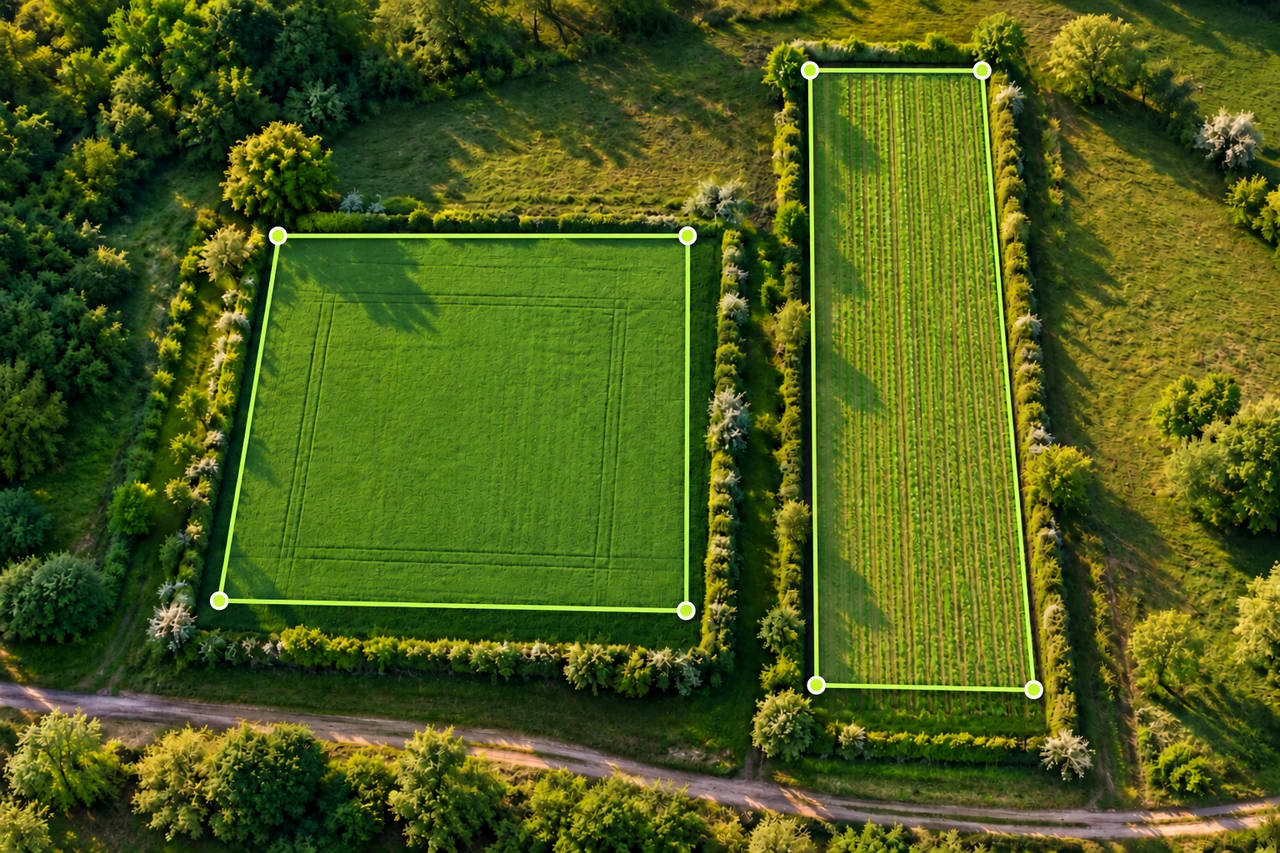
If the shape is known to be a square, area = side². A square of 10,000 m² therefore has a side of √10,000 = 100 m. Its perimeter is four times that side, or 400 m. The square assumption supplies the relationship that makes the answer possible.
Taking a square root of an unknown plot's area gives the side of an equivalent square, not the actual boundary length or an identified side of the plot. Label that result carefully when using it as a rough visual comparison.
Inspect the calculation diagram
A rectangle needs another dimension
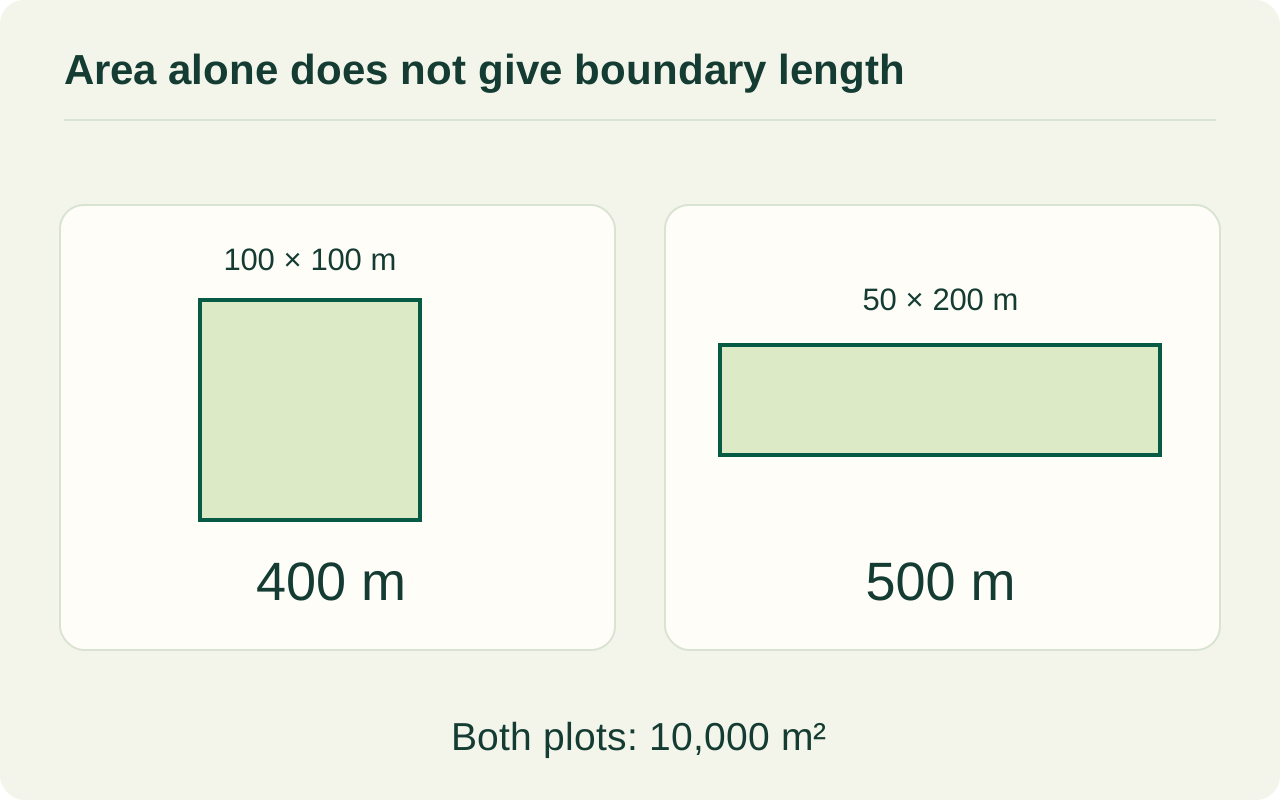
For a rectangle, area = length × width. If area is 10,000 m² and width is 50 m, length is 10,000 ÷ 50 = 200 m. If width is 100 m instead, length is 100 m. Both answers fit the same area because the width changed.
Keep units in the calculation: m² divided by m leaves m. This is a useful check that you are calculating a length. For a strip of constant width, the same rectangle model can estimate length, provided the stated width really applies throughout.
Equal perimeter does not mean equal area
Consider two rectangles with perimeter 400 m. A 100 × 100 m square encloses 10,000 m², while a 50 × 150 m rectangle encloses 7,500 m². Both satisfy 2(length + width) = 400. Knowing the boundary total has not told us how that length is distributed among the sides.
The reverse also fails. A 100 × 100 m square and a 50 × 200 m rectangle both contain 10,000 m², yet their perimeters are 400 m and 500 m. These paired examples explain why a single area or perimeter total leaves multiple possible layouts.
| Rectangle | Area | Perimeter |
|---|---|---|
| 100 × 100 m | 10,000 m² | 400 m |
| 50 × 150 m | 7,500 m² | 400 m |
| 50 × 200 m | 10,000 m² | 500 m |
Find the missing fact before calculating
When someone asks how many metres are in a stated area, ask which length they need: one side, total boundary, or the length of a fixed-width strip. Then identify the shape and the additional measurement. Even a four-sided plot need not be a rectangle; right angles cannot be inferred from its name.
Do not divide area by perimeter and label the answer as a side. Although the resulting unit is a length, it is generally not the requested dimension. Units can expose some errors, but the equation must also match the geometry.
Use the tool that matches the information
Use LandRuler's unit converter when you need to express an existing area in another area unit. To estimate the area and boundary of a visible plot, use the area tool and draw its outline. To measure a particular side or path, use the distance tool.
Keep the original measurement and its unit beside any derived result. A note such as rectangle assumed, width 50 m makes a calculated length understandable later. If the shape is unknown, leave the missing dimension unresolved instead of hiding an assumption inside a conversion.
Common questions
How many metres is 1,000 m²?
There is no single answer. If it is a square, each side is approximately 31.62 m. If it is a 20 m wide rectangle, its length is 50 m.
Can a known shape make perimeter sufficient?
Yes, if the shape imposes enough relationships. A square with perimeter P has side P/4 and area (P/4)². A general rectangle still needs another constraint.
Sources and calculation notes
Figures and numerical scenarios are explanatory examples, not observed field results or application screenshots. Sources support the concepts listed below.
- OpenStax: Area
Basic rectangle and circle formulas; worked comparisons are original calculations.
- NIST: SI Units – Area
Square metres as area units and hectares as 10,000 m².
- NIST: Circumference, Area and Volume
Distinguishing boundary length from surface area.
Continue learning
Planning and quantities
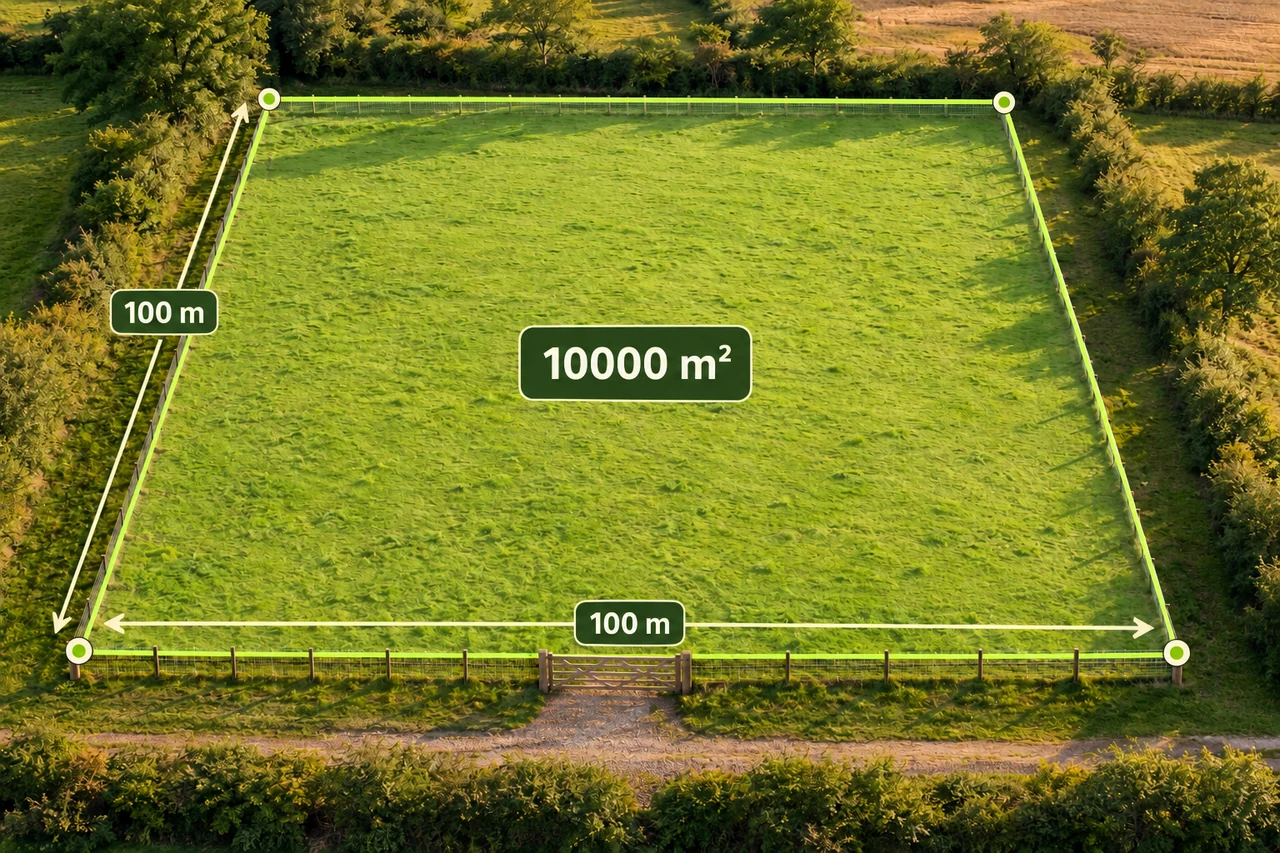
How much fence does one hectare need?
Compare three one-hectare shapes, subtract a gate, and turn perimeter into a careful first fencing materials estimate.
Read the guide →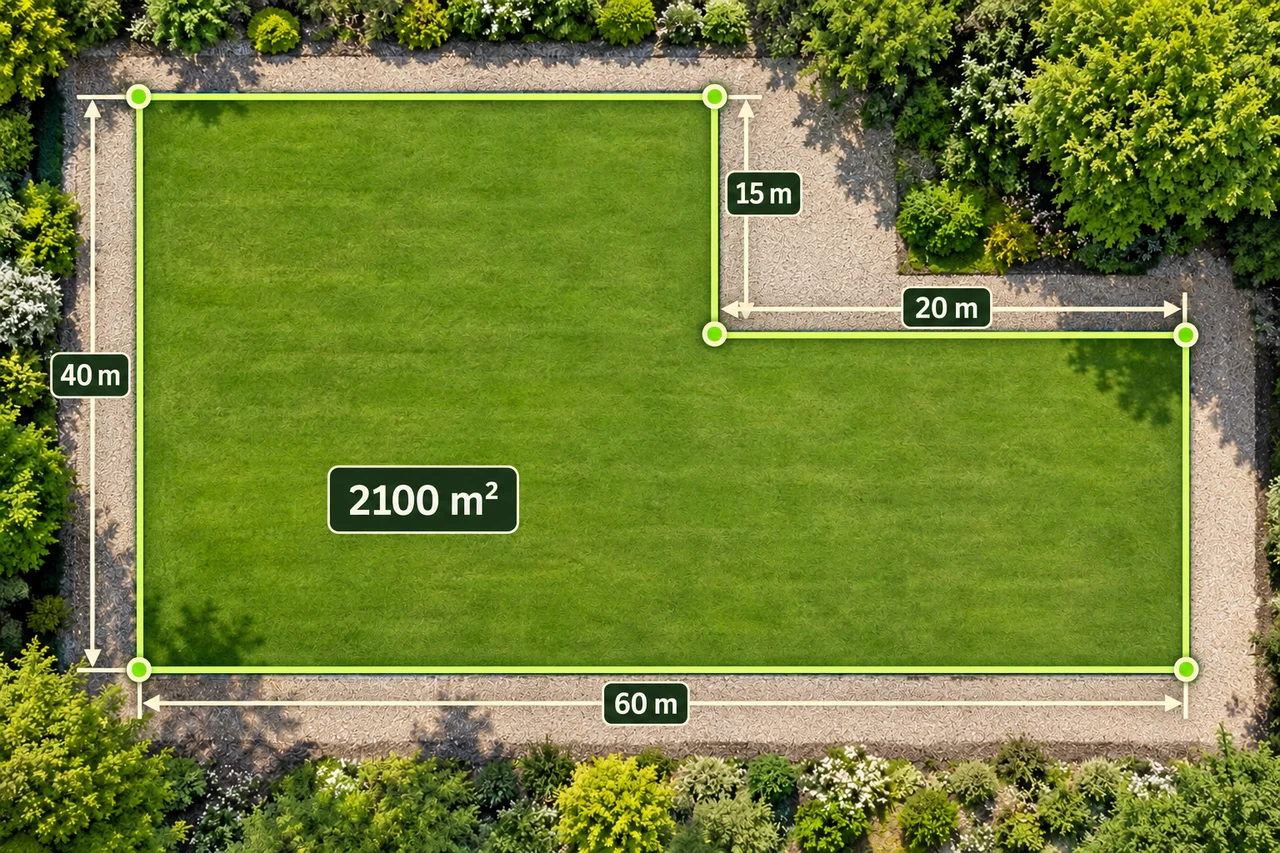
Land shapes and geometry
Calculate L-shaped land area in two ways
Find a concave plot's area by subtracting a missing corner or adding rectangles, then check every boundary segment.
Read the guide →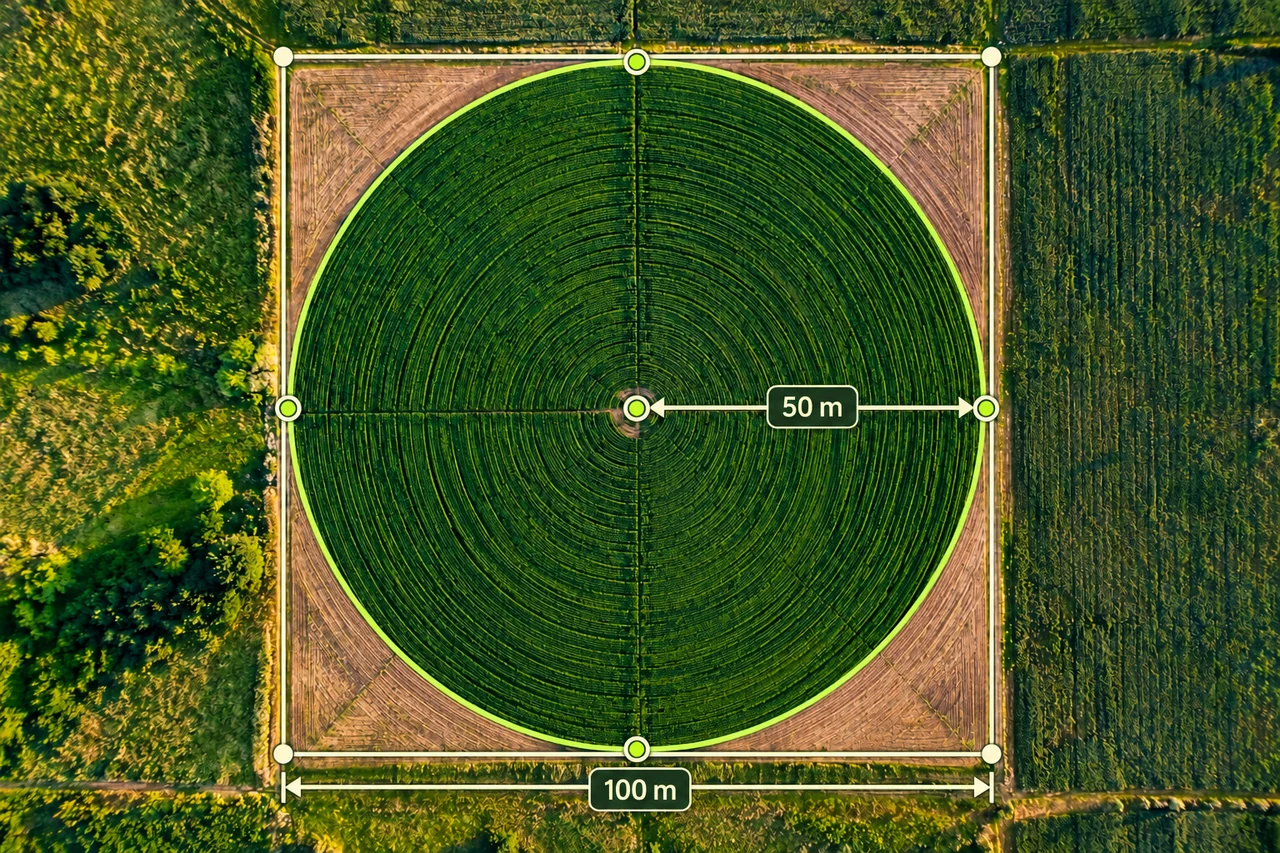
Land shapes and geometry
How much of a square field does a circle cover?
Compare a 50 m radius circle with a 100 × 100 m field, calculate uncovered corners, and separate geometric coverage from equipment performance.
Read the guide →