Measurement guide
Land shapes and geometry
How much of a square field does a circle cover?
A circle can touch every side of a square and still leave a substantial part of the field outside it. The useful question is how much land lies inside the circle, rather than whether its diameter matches the field width.
Land Ruler · · 4 min read
Define the footprint before comparing areas
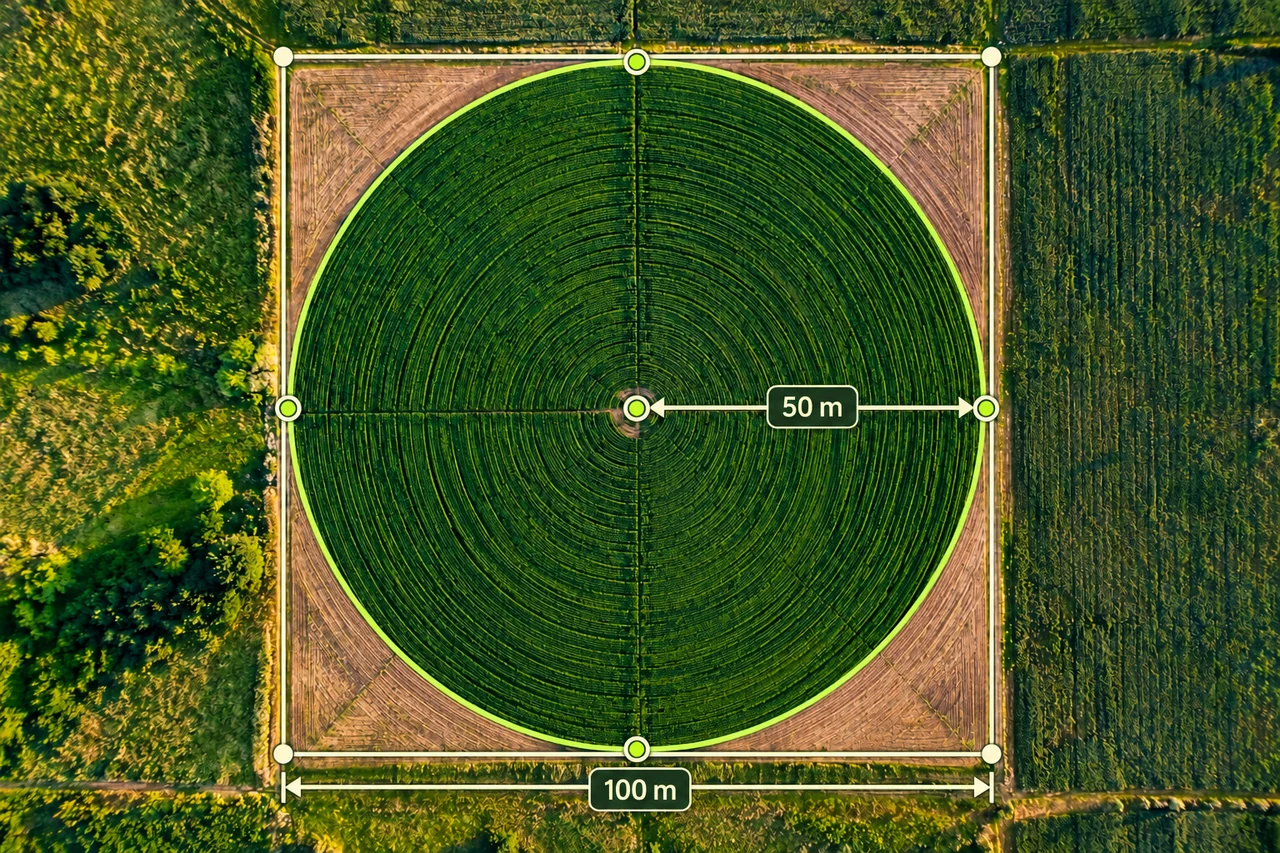
Imagine a perfectly square, level plan with sides of 100 m. Place the circle center at the square center and give it a radius of 50 m. Its diameter is therefore 100 m, so it just reaches the midpoint of each side. This arrangement is an inscribed circle: the entire circular footprint lies inside the square.
That last condition matters. If the center moves or the radius increases, some circle area may fall outside the field. You would then need the overlap area, rather than the area of the whole circle, to calculate the fraction covered.
Calculate the square, circle, and remainder
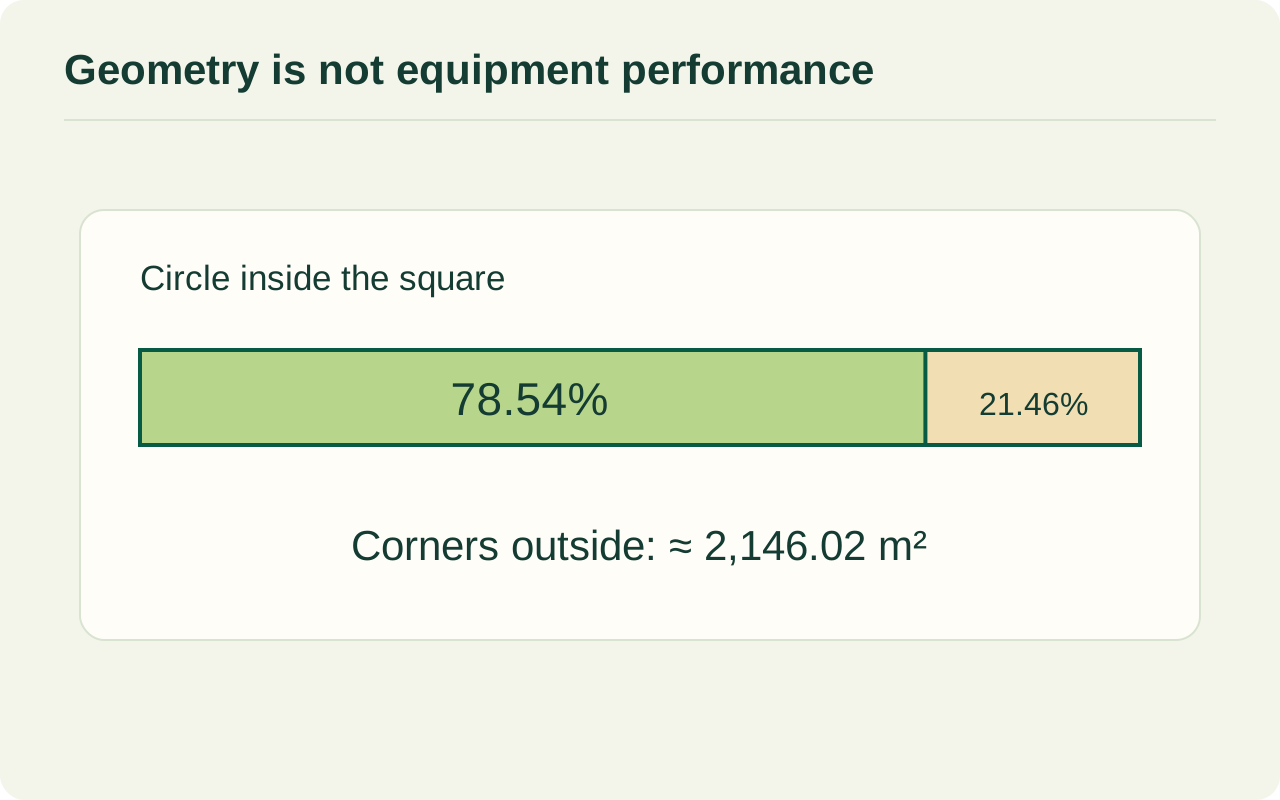
The square area is 100 × 100 = 10,000 m². The circular area is π × 50² = 2,500π m². Using a calculator value of π gives approximately 7,853.9816 m². Subtract this from the square to obtain the combined uncovered corner area: 10,000 − 7,853.9816 = 2,146.0184 m².
Coverage is a ratio: divide circle area by square area, then multiply by 100. Here that gives approximately 78.5398%. Keep the unrounded result until the final step; rounding the radius or π early can make independently calculated totals disagree.
| Quantity | Calculation | Result |
|---|---|---|
| Square | 100 × 100 | 10,000 m² |
| Circle | π × 50² | ≈ 7,853.9816 m² |
| Uncovered corners | 10,000 − 2,500π | ≈ 2,146.0184 m² |
| Coverage | (π/4) × 100 | ≈ 78.5398% |
Inspect the calculation diagram
Understand why the corners remain outside
A side midpoint is 50 m from the center, but a corner is farther away: √(50² + 50²), approximately 70.71 m. Reaching the side midpoint therefore says nothing about reaching the corner. The four uncovered regions are equal in this centered example, each approximately 536.5046 m².
Using the exact center-to-corner distance as the radius would reach the corners, but would also put much of the circle outside the square. The displayed 70.71 m is a rounded description of that distance, not an exact reach threshold. That is a different comparison. A larger circle area cannot simply be counted as useful field coverage when part of it extends beyond the boundary.
The proportion stays the same when scaled
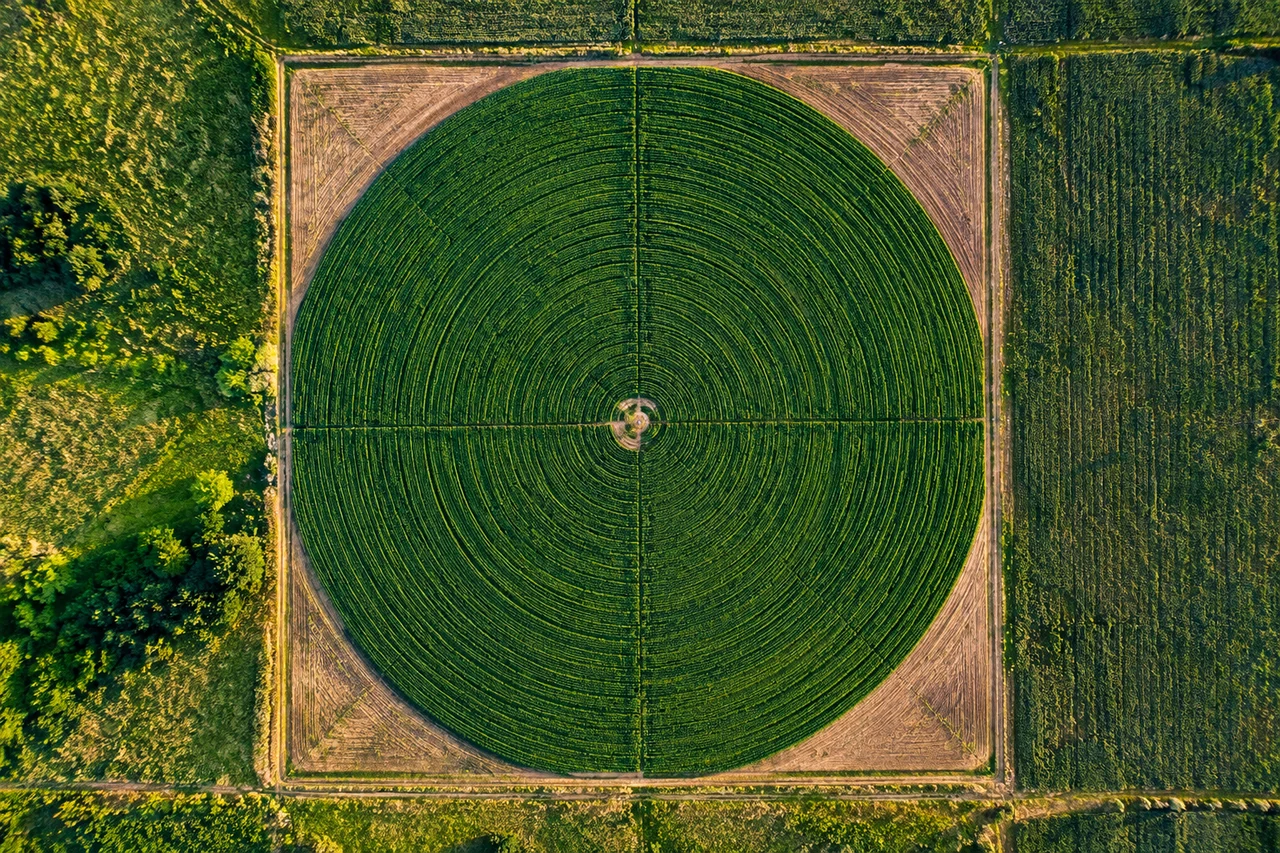
For any square with side s and an inscribed circle, r = s/2. Dividing π(s/2)² by s² leaves π/4, approximately 0.785398. A 20 m square and a 200 m square therefore have the same coverage percentage under these exact geometric assumptions.
The uncovered area in square metres does change with size. Doubling every length multiplies both square and circle areas by four. Use the percentage for comparing similar layouts, and use square metres when estimating how much physical ground remains outside the footprint.
Avoid turning geometry into a performance claim
This calculation describes a sharp circular boundary on a flat plan. It does not design an irrigation system or establish uniform water application. Wind, actual throw, pressure, overlap, and equipment characteristics are unknown here. A circular drawing also cannot guarantee radio, wireless, or other signal coverage.
Two common input mistakes are entering the 100 m diameter as a radius and comparing metres directly with square metres. The first makes the circle area four times too large; the second compares different quantities. Check the center position and the radius label before interpreting the percentage.
Try the same comparison with your measurements
Open the LandRuler circle tool and enter a measured or deliberately chosen radius. Compare its area with the field area from the area tool only when the circle is fully inside that field. Record both assumptions beside the result, including whether the field was treated as a perfect square.
For an irregular field, first draw the actual boundary. A radius result alone does not reveal how much of an irregular outline overlaps the circle. The simple square example is a useful reference case for checking your arithmetic before moving to a more detailed layout.
Common questions
Does touching all four sides mean full coverage?
No. In this centered example the circle reaches the side midpoints, while approximately 21.4602% of the square remains outside it.
Can I use the same percentage for a rectangle?
Only for a square with the stated inscribed-circle geometry. A rectangle needs its own dimensions and a check of where the circle lies.
Sources and calculation notes
Figures and numerical scenarios are explanatory examples, not observed field results or application screenshots. Sources support the concepts listed below.
- OpenStax: Area
Basic rectangle and circle formulas; worked comparisons are original calculations.
Continue learning
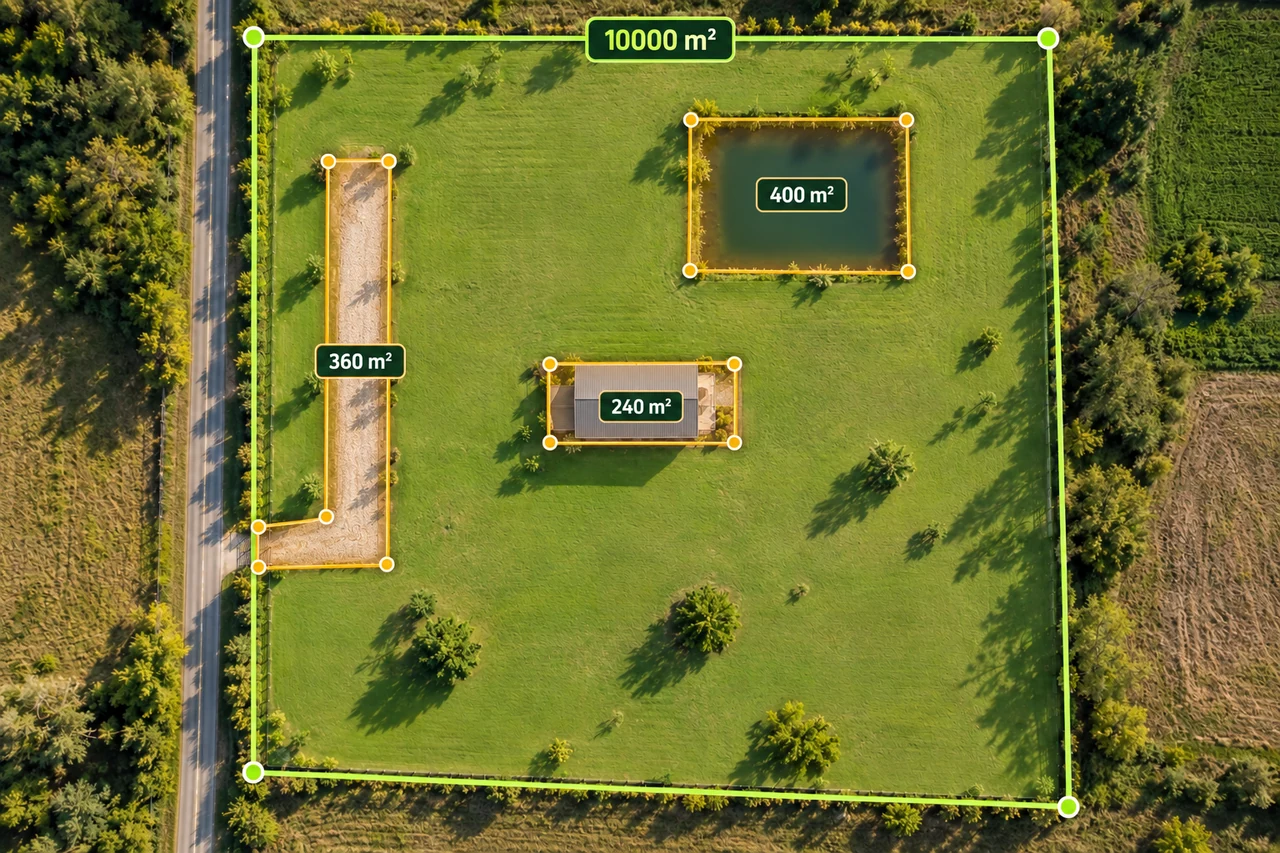
Planning and quantities
Calculate usable land area without subtracting twice
Build a transparent gross-to-net land area worksheet with buildings, access and water exclusions, including overlapping shapes.
Read the guide →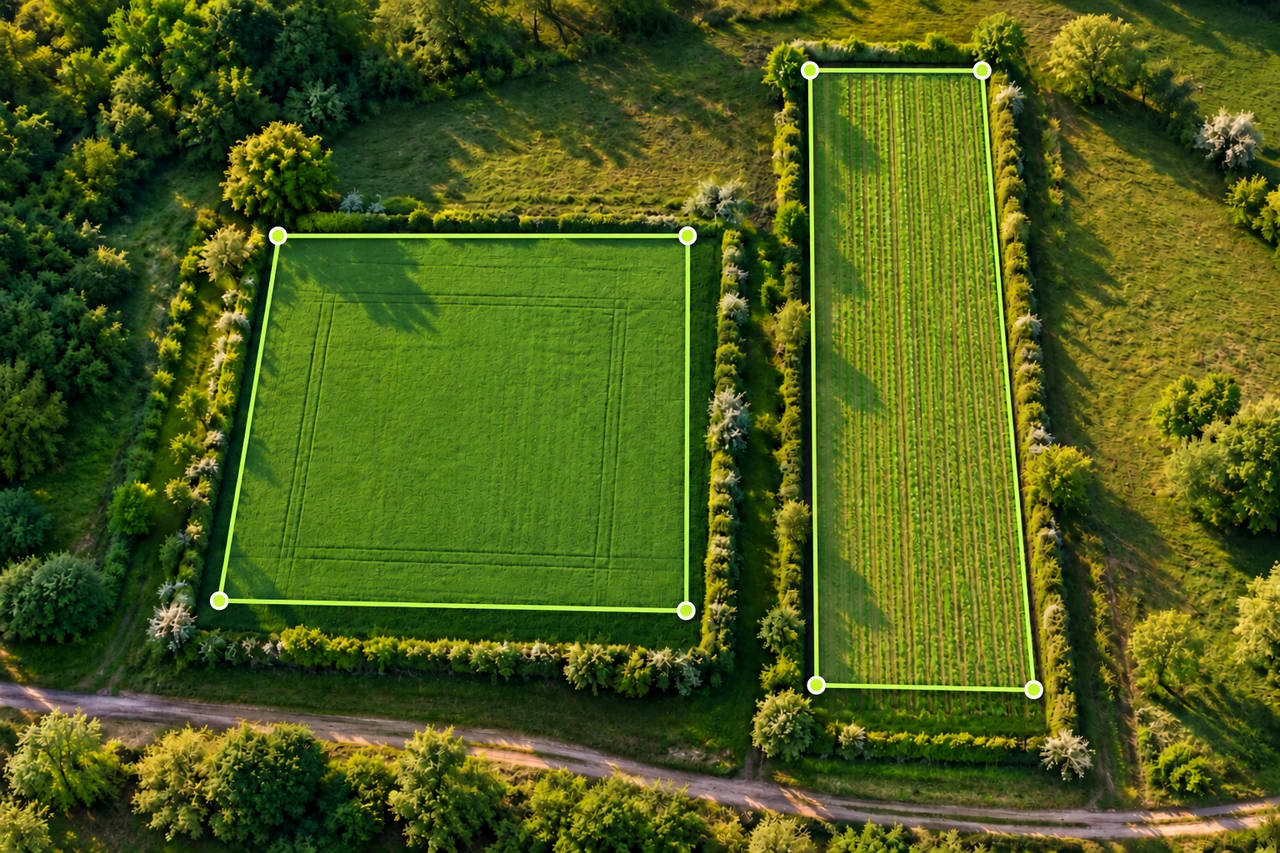
Land shapes and geometry
Can square metres become metres? Can perimeter give area?
Understand the missing dimensions behind area-to-length questions, with rectangles that share a perimeter or area but have different shapes.
Read the guide →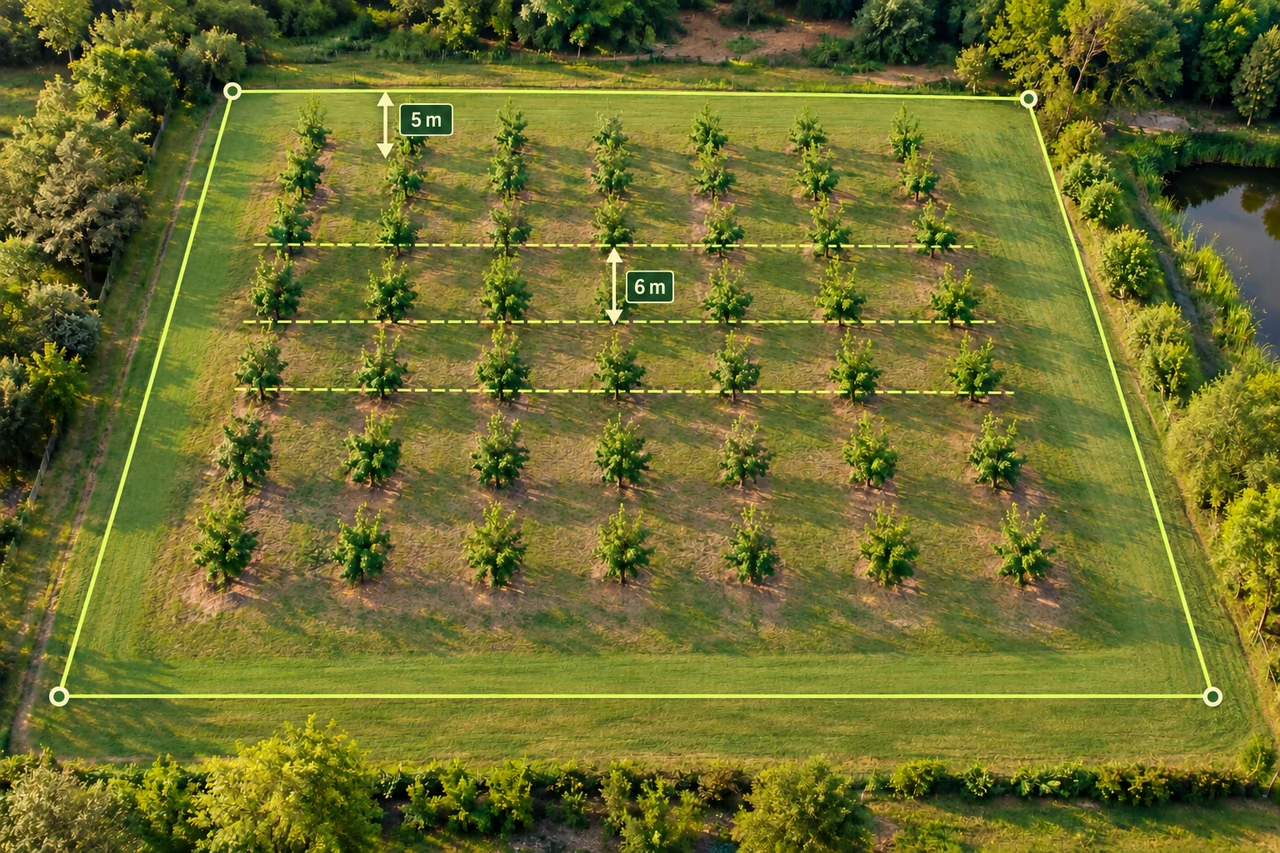
Planning and quantities
Count orchard planting positions with an explicit grid
Work through a 100 × 60 m plot, 5 m margins and 6 m spacing to see why a grid count differs from area divided by spacing.
Read the guide →