Measurement guide
Planning and quantities
Calculate soil volume from area and layer depth
An area measurement is the starting point for a soil, mulch or aggregate estimate, but suppliers usually need a volume or a mass. Layer depth provides the missing dimension. Keeping units consistent gives a clear geometric quantity; deciding what to order then requires knowing the material, the ground shape and how the specified depth will be achieved.
Land Ruler · · 4 min read
Convert depth before multiplying
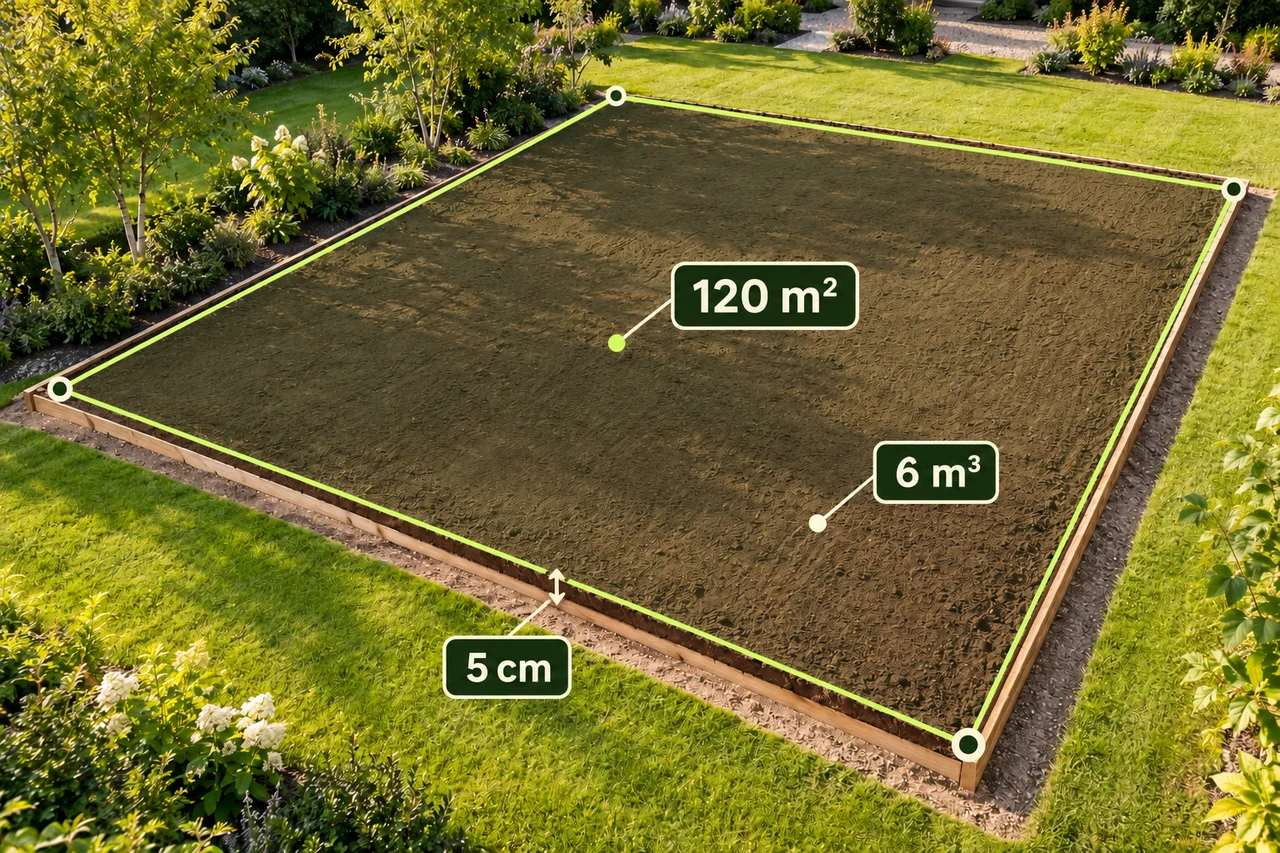
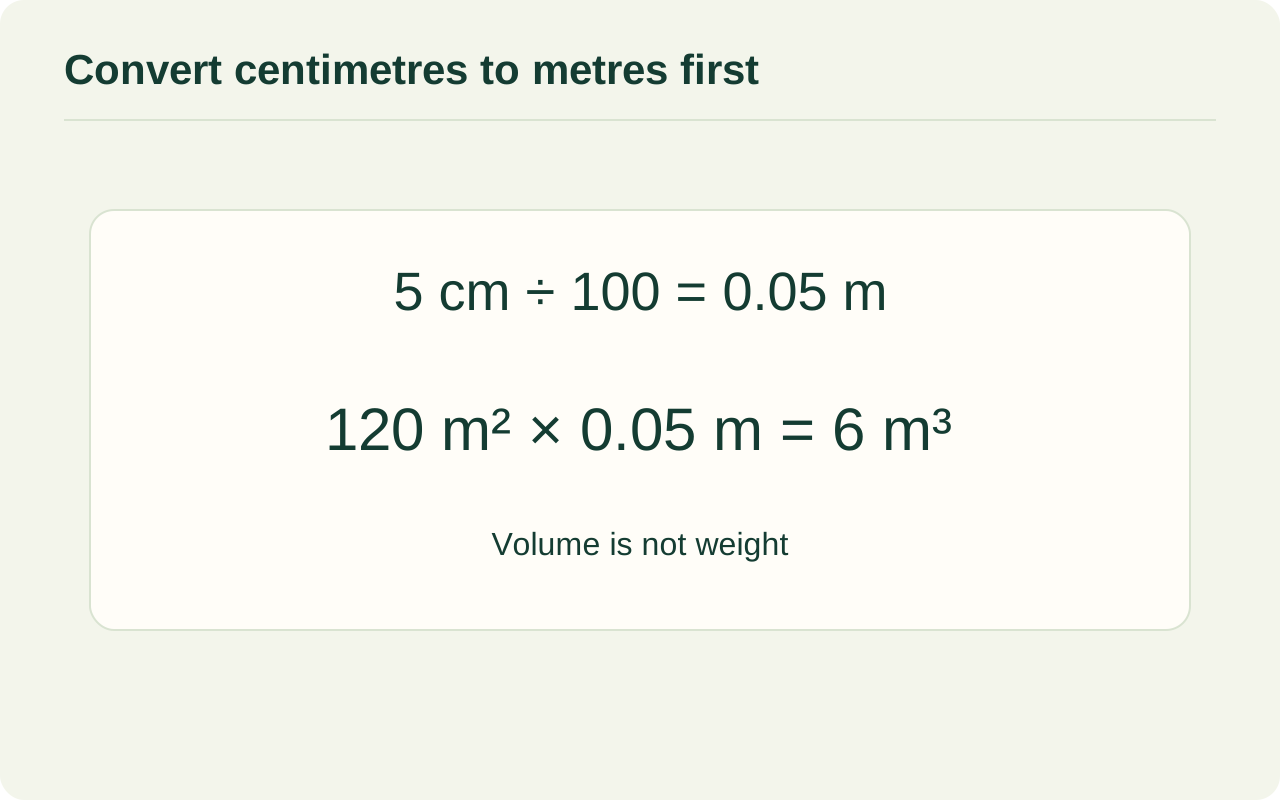
Square metres multiplied by metres produce cubic metres. Centimetres therefore need dividing by 100 before they enter this formula. Writing 120 × 5 = 600 and labelling the answer cubic metres introduces a hundredfold error. Show the conversion as its own line rather than relying on a mental adjustment. If a supplier uses litres for bag sizes, 1 m³ equals 1,000 litres, so the geometric 6 m³ volume is 6,000 litres.
Check how much the depth changes the answer
Holding the 120 m² area constant makes depth sensitivity easy to see. Every additional centimetre adds 120 × 0.01 = 1.2 m³. A depth chosen casually from a photograph can therefore create a meaningful difference in the order. The depths in the table are arithmetic comparisons, not recommendations for soil improvement or plant care. Choose the appropriate material and layer depth for the actual job before treating any row as your target.
| Depth | Metres | Volume |
|---|---|---|
| 3 cm | 0.03 m | 3.6 m³ |
| 5 cm | 0.05 m | 6 m³ |
| 8 cm | 0.08 m | 9.6 m³ |
Inspect the calculation diagram
Measure the surface that actually receives material
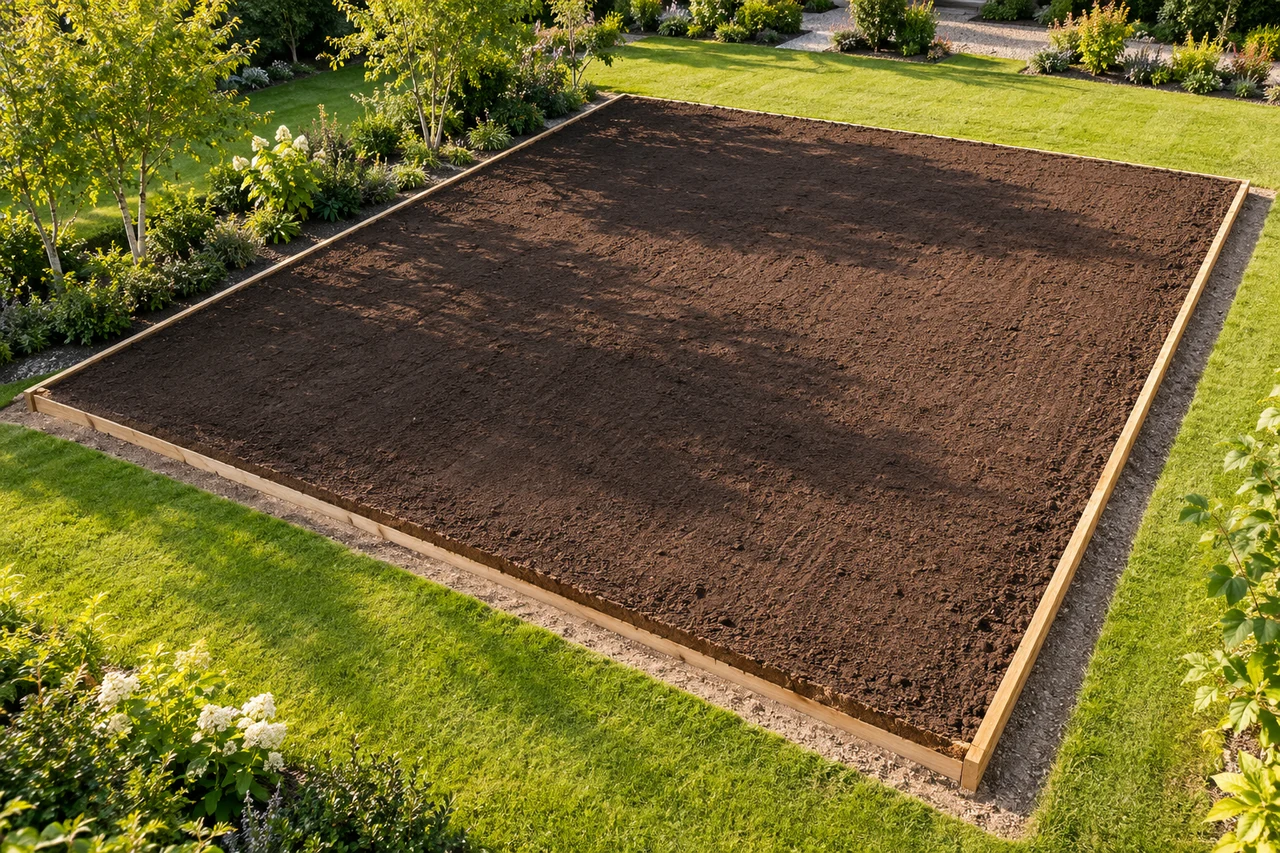
Trace the application footprint rather than the whole property. A patio, pond or untouched planting bed should be excluded if no material goes there. For separated beds, measure each area and add them, avoiding overlaps. A map gives a horizontal footprint suitable for an early estimate. On sloping or uneven ground, the relevant spread surface and the meaning of depth need site assessment. A uniform layer and filling a depression to a level finish are different geometric tasks.
Split the job when depths differ
Suppose 80 m² needs 5 cm and another 40 m² needs 10 cm. Calculate 80 × 0.05 = 4 m³ and 40 × 0.10 = 4 m³, then add them to obtain 8 m³. Averaging the two depths without weighting them by area would produce a different result. If neither depth is known reliably, measure several representative locations and describe the uncertainty instead of presenting a precise-looking total as a verified quantity.
Separate geometric volume from delivery quantity
Loose material, a settled layer and a compacted finished layer need not occupy the same volume. There is no universal extra percentage that fixes this for every soil or aggregate. Ask the supplier which state their quantity describes and whether the specified depth is loose or finished. Do not convert 6 m³ into tonnes using an assumed universal density. Mass = volume × bulk density, with compatible units and a density relevant to the actual material and moisture condition.
Match the quote to the calculation
Keep three quantities visible when reviewing a quote: the geometric requirement, any separately explained adjustment, and the packaged or bulk amount supplied. For bags labelled in litres, divide the required litres by the labelled litres per bag and round the bag count upward. Do this only after deciding which material state the requirement describes. A price per tonne cannot be compared directly with a price per cubic metre without a suitable density. If a quote combines quantities or units, ask for them separately instead of changing your measured area to make the totals match.
Prepare a clear material request
Measure the application area with LandRuler, record the selected depth separately, and keep the conversion beside your multiplication. For this example the request starts with '120 m², target layer 5 cm, geometric volume 6 m³.' Add the intended material and ask about delivery units, settlement and any justified allowance. Confirm access and unloading arrangements before ordering. LandRuler's area and unit tools support the measurement inputs; the layer calculation remains an explicit planning step rather than an automatic material specification.
Try your own numbers
This calculation uses the geometric assumptions explained in the article.
Common questions
Can I calculate soil weight from area and depth alone?
No. Those inputs give volume. A mass estimate also needs material-specific bulk density in compatible units, under relevant conditions.
Should I always add ten percent?
No fixed percentage fits every material or site. Keep the geometric volume visible and agree any adjustment with the supplier or installer.
Sources and calculation notes
Figures and numerical scenarios are explanatory examples, not observed field results or application screenshots. Sources support the concepts listed below.
- Iowa State Extension: Determine mulch quantity
Supports volume as area times depth and converting depth into the same length unit first. All metric examples here are original.
- NIST Handbook 44: Appendix C, units
Supports metric length relationships used for the centimetre-to-metre conversion.
- NIST: SI Units — Volume
Supports the equivalence of 1 cubic metre and 1,000 litres for matching geometric volume to labelled bag units.
Continue learning
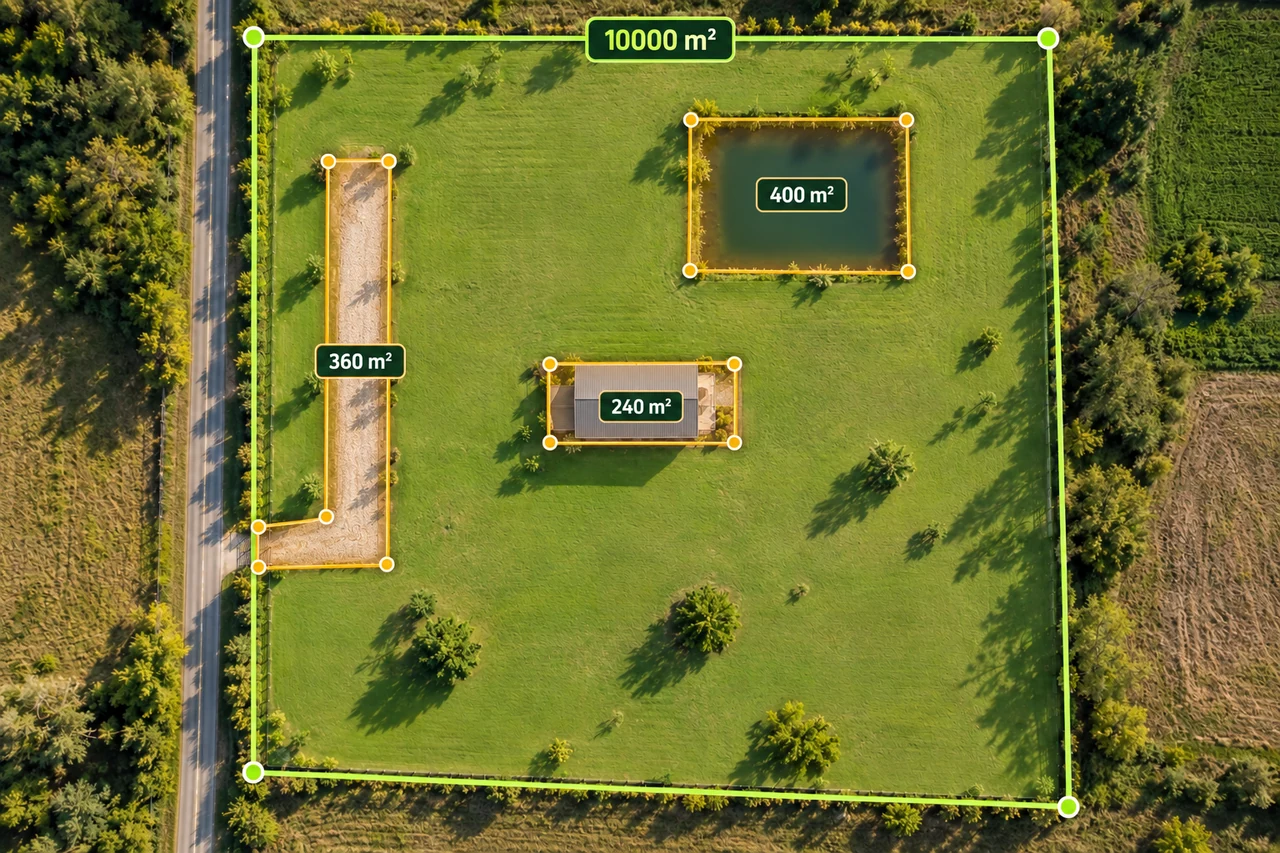
Planning and quantities
Calculate usable land area without subtracting twice
Build a transparent gross-to-net land area worksheet with buildings, access and water exclusions, including overlapping shapes.
Read the guide →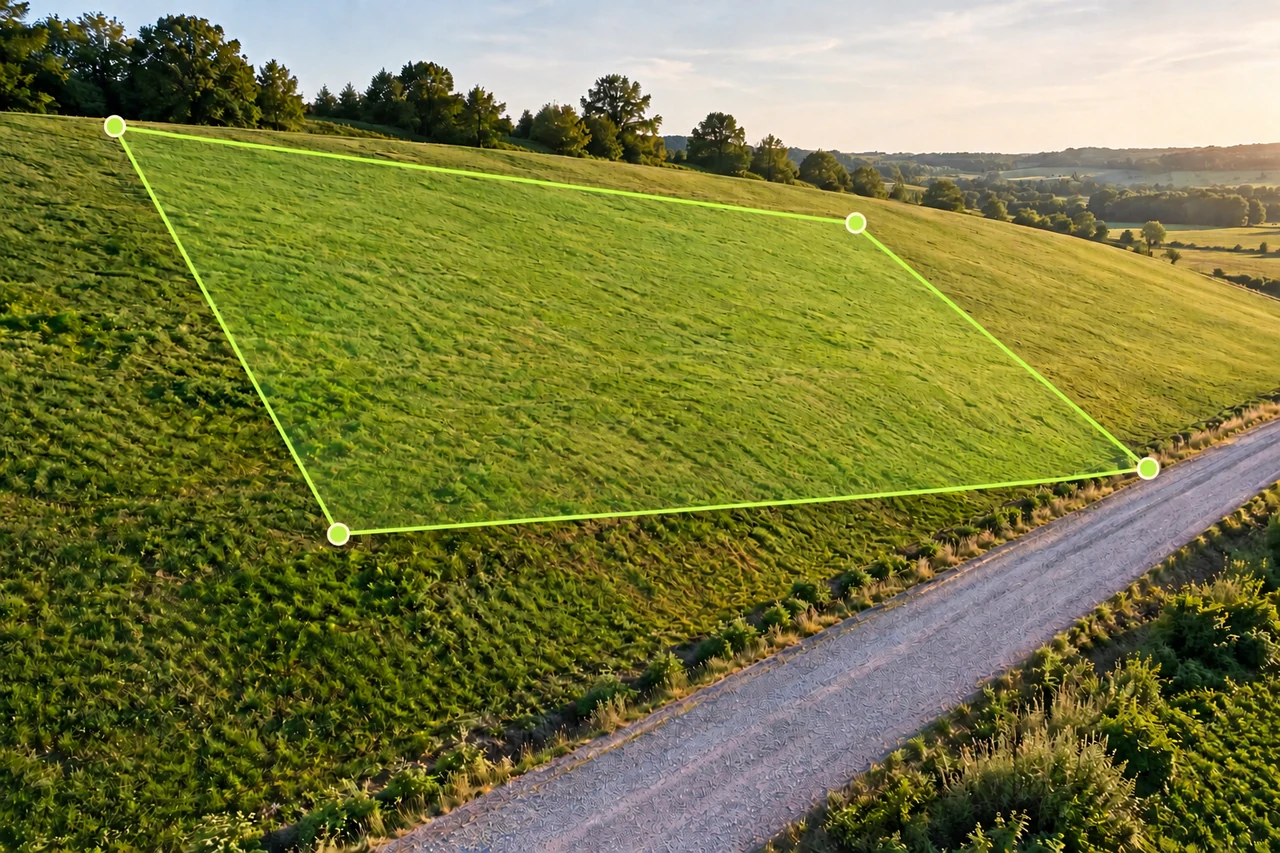
Accuracy and coordinates
Horizontal land area vs sloped surface area: a worked example
Learn why map area and hillside surface area differ, calculate a uniform 20° slope example, and avoid applying average slope to irregular terrain.
Read the guide →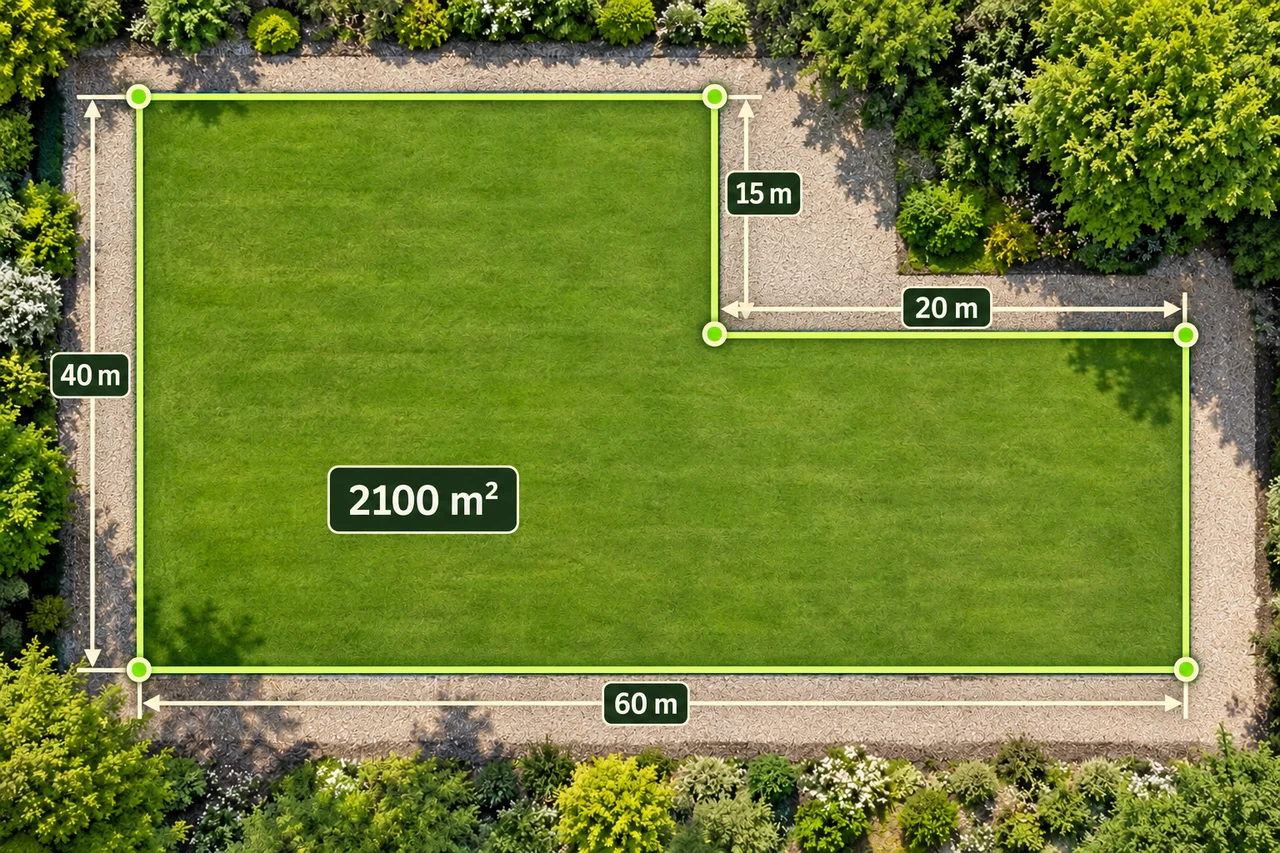
Land shapes and geometry
Calculate L-shaped land area in two ways
Find a concave plot's area by subtracting a missing corner or adding rectangles, then check every boundary segment.
Read the guide →