
From area to paver quantity
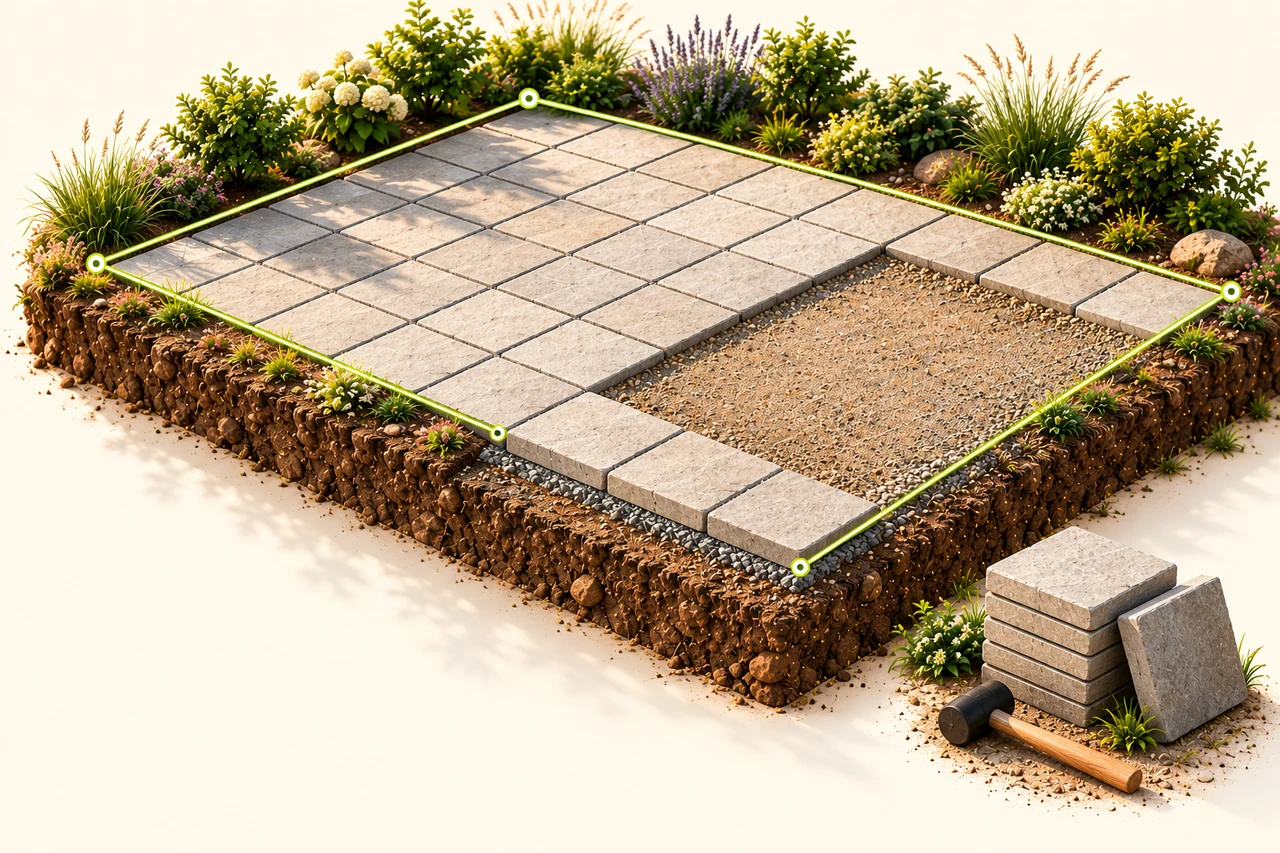
Multiply one paver’s nominal length by its width to find nominal area per piece. Add your waste allowance to the area to cover, divide by the nominal piece area, and round upward to whole pavers.
For 100 m² with 40 ×40 cm pavers and zero waste, one piece covers 0.16 m² and the estimate is 625 pavers. With a 10% allowance, 110 m² divided by 0.16 m² gives 687.5, so the estimate becomes 688 pavers.
An area-based quantity estimate
Use the supplier’s stated nominal dimensions. This calculator does not model laying patterns, individual cuts, reuse of offcuts, joint width, thickness or load-bearing strength. Joint spacing is reflected only if it is included in the nominal module dimensions you enter. Your waste allowance is an input, not an installation recommendation.
Paver quantity questions
Can I mix square feet with centimetres?
Yes. Area supports m², hectares, decares, international acres and ft²; paver dimensions support centimetres, inches or metres. Results show area in your selected area unit.
Why is the result rounded upward?
The nominal coverage of whole pieces must meet the area after your waste allowance. Extra after rounding is coverage above that adjusted area, not a guarantee that every piece or offcut fits a particular layout.
Can it calculate irregular stone or joint widths?
The calculation uses rectangular nominal coverage only. Enter a supplier-provided rectangular module if appropriate. There is no separate joint or irregular-shape model.